
The Trust Issue
Trust And Other Philosophical Musings

Places The Mind Goes When Writer’s Block Hits
Trust And Respect
Hey friends, go grab your cushy plush robe and slippers, curl up in your lazy-boy and pull the lever to put your feet up—we’re getting philosophical today…
Trust is given; it can not be taken; but it can be broken.
Respect is earned, not given, and can be lost.
Neither can be forced upon you.
A relationship, a healthy one anyway, can not subsist without either. But first, one must have trust in self and self-respect.
Both emotional trust and legal trusts are the foundation of my upcoming novel, One of Us Must Die. Researching how and why families create trusts provided an interesting learning experience. And while emotional trust and the importance of respect are deep factors in the story as well, why are they buzzing around now, begging for their layers to be peeled down to the inner core? The book is done; pre-sales will appear within a few months; the next story wants so badly to be brought to life. Yet, the inner musings of trust and respect are blocking the path.
We all spend our trust differently. There are the ‘trust openly and easily’ types. Sometimes they get burned. No matter, they might think as they open their emotional wallets and pay out their trust to the next person. Then there are the ‘frugal trusters.’ They carry scars from those burns, and won’t forget it. Their emotional wallets have padlocks, opened only after someone finds the secret to dismantling the impenetrable moats around their hearts. So who are ‘healthy trusters’? Filled with self-trust and respect, they are wise with their emotional wallets. They take time to evaluate how they will invest their trust—is the person ‘a man-woman-person of their word,’ consistent, reliably honest? The ‘healthy truster’ will build trust before giving it away. At some level, no matter what type of truster you are, it requires vulnerability. Can we be vulnerable? Not without self-trust and self-respect—at least not in this hypothetical, philosophical theorem.
Have you noticed a word that keeps coming up—respect? Before we can trust you, we must respect you. But how does one earn respect? Good morals (who gets to define that?), politeness, showing appreciation, compassionate, socially apt, vulnerable and openness, sharing themselves, responsibility, strong work ethics…
can someone put this list on their “what I’m seeking” dating profile and see if there is an actual human match?
For all the different ways we trust, and the multitude of ways to earn respect, it takes one simple snap to break that trust, one simple misstep for respect to be withdrawn. So easy. Gaining it back? Well, that’s a hurdle, and of course depends on your level of trust openness, doesn’t it? All of which, at least on the truster’s side, requires forgiveness. And that, my dear readers, is a whole other deep discussion, but alas, our allotted armchair philosophical therapy time is at an end for today.
I Read It:
I did something I haven’t done in YEARS. I read a book in ONE day!!
Kaira Rouda’s book Jill Is Not Happy, a stupendously edge-of-seat thriller, is plumb with deliciously unreliable narrators. A brilliant book and its characters stay with you after “the end.” It’s plausible Jill is Not Happy sparked the above exploration of who we can trust.
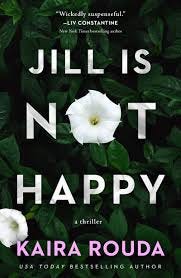
JILL IS NOT HAPPY FINAL SCORE:
1/2 READING DAYS - 𝟎 LIFE INTERRUPTUS = 5/16 ACTUAL READING DAYS
The rating scale: Take the number of days to read, subtract all of life’s responsibilities, obligations, fun, and a few hours of sleep each night, and this chilling, psychological thriller scores a 1/2 day read!
And Now For Something Completely Serious…
Is A Brain Aneurysm Contagious?~ Part 2
For those of you just joining us, you can read details of my diagnosis and my aneurysm story in the Snarkastic archives.
In our last segment, it was eleven months after successful surgery for an unruptured brain aneurysm. You’d kept the promise to your neurosurgeon: “If you fix my brain, I’ll use it.” One way was to become a passionate advocate for brain aneurysm awareness and research. As such, you were in the middle of a fundraising event when a friend found out you knew her secret: she’d survived a terrible brain aneurysm rupture and faces a long road of recovery. She immediately picks up the phone, calls, and oddly, you answer it. Two friends, brain aneurysm survivors, reconnecting in the middle of a brain aneurysm 5K. The universe is weirdly exceptional.
Two weeks later, you attend a gala you helped organize, another fundraiser for brain aneurysm awareness and research. At your table sit your family and a friend whose husband recently survived a ruptured brain aneurysm. There are speeches over dinner that largely no one pays attention to, until someone spouts off the statistics, who is more likely gets aneurysm (women over 40), and those who have (blood) family history of aneurysms. Meaning you. You’ve now created that history and risk for your loved ones. Slowing looking around the table, you observe your children and siblings, and with strange new emotions, you wonder about their future. Can you keep them safe?
One year later, you are once again walking the brain aneurysm awareness 5K, an annual milestone to celebrate and appreciate life, unaware that your sister-in-law has just suffered a terrifying ruptured brain aneurysm.
There are more coincidences: another (non-blood) family member discovered and treated an unruptured aneurysm; two childhood friends also survived and treated unruptured aneurysms; a third’s husband suffered a rupture; a college friend’s father had one; a classmate suffered a rupture and didn’t survive.
So, are aneurysms contagious? Most certainly not. Statistics claim that 1 in 50 people has an unruptured brain aneurysm. Most don’t even know they have one until it’s an emergency. Once you talk about them, though, you uncover so many instances that prove it is far more prevalent than anyone realizes. We should talk.
To be continued…stick around for the next issue of Sometimes Snarkastic
Last Licks

From my perspective, respect and trust are so intertwined, interconnected. And the factors - or clues - by which I assess (consciously, or more often, unconsciously) someone on those qualities are more intuitive than measurable. Certainly I can respect someone for their demonstrated intelligence, skill, or competence, but that doesn't mean my respect for a brilliant engineer will automatically translate to trust he will keep my secrets. Invariably it comes down to their eye contact, facial & body language, tone of voice, listening, dialogue & exchange, demonstrated emotions/feeling, thought processes, opinions, -- dozens of intangible factors that convey the humanity (or lack thereof) in a person. And you're right: one instance of failure in respect or trust kills the whole thing. And it can rarely be salvaged. Forgiveness cannot erase memory.